
Picture a place where the grind never stops, where callouts echo through hallways at 3 AM, and where your teammates are just down the hall instead of scattered across time zones. That’s the reality of a gaming house, a concept that’s evolved from a curiosity into a legitimate competitive advantage in 2026.
Gaming houses aren’t just crash pads with gaming rigs anymore. They’re purpose-built training facilities where professional esports teams sharpen their strategies, content creators collaborate on viral projects, and aspiring pros transform their passion into careers. Whether you’re a competitive player eyeing the next major, a streamer looking to expand your network, or just curious about how the pros live and train, understanding the gaming house model reveals a lot about where competitive gaming is headed.
This guide breaks down everything from what actually defines a gaming house in 2026, why teams still invest in them even though remote training tools, and how you might build one yourself. Let’s immerse.
Key Takeaways
- A gaming house is a shared living space combining team housing, gaming infrastructure, and content creation facilities that accelerates training efficiency and team synergy for esports professionals and content creators.
- Gaming houses deliver tangible competitive advantages through faster in-person communication, cost savings via shared resources, and content production capabilities that remote setups struggle to replicate.
- Successful gaming house setups require enterprise-grade networking (gigabit fiber minimum), dedicated gaming stations with high-end PCs, private bedrooms for recovery, and clear house rules to prevent burnout and personality conflicts.
- A five-person gaming house typically costs $27,000–$60,000 to set up and $4,000–$8,100 monthly ($800–$1,620 per person), with hybrid models becoming the norm to balance efficiency with personal space and reduce burnout.
- The future of gaming houses emphasizes hybrid remote-in-person training, VR coaching, AI-powered analytics, and content integration rather than pure year-round cohabitation, allowing teams flexibility while preserving competitive edge when it matters most.
What Is a Gaming House?
A gaming house is a shared living space where esports professionals, content creators, or competitive gaming teams reside together, primarily to train, collaborate, and compete under one roof. Think of it as equal parts team facility, content studio, and home.
Unlike traditional athletic training centers where players commute for practice, gaming houses combine living quarters with full-scale gaming infrastructure. Teams typically lease or purchase a multi-bedroom property, outfit it with high-end PCs or consoles, robust networking gear, and dedicated practice areas. Residents share expenses, coordinate schedules, and, ideally, build the kind of chemistry that translates to better in-game performance.
The model gained traction in the early 2010s with League of Legends and Counter-Strike teams, but by 2026 it’s expanded well beyond traditional esports. You’ll find gaming houses for mobile esports squads, variety content creator collectives, and even competitive speedrunning groups.
The Evolution from Solo Gamers to Team Living Spaces
Back in the day, pro gamers ground it out solo from bedrooms or LAN cafes. Communication happened over Discord or TeamSpeak, scrims were scheduled around conflicting sleep schedules, and team synergy was mostly theoretical.
As esports organizations started securing sponsorships and tournament winnings grew, teams realized they needed more than raw mechanical skill. They needed cohesion, faster feedback loops, and the ability to drill strategies without latency or scheduling headaches. Gaming houses emerged as the solution.
Early examples were scrappy, five guys cramming into a three-bedroom apartment with questionable wiring and neighbors who definitely called the cops during late-night scrims. But as the industry matured, so did the houses. By 2020, top-tier orgs were leasing mansions in LA, Seoul, and Berlin. In 2026, some houses rival small production studios, complete with dedicated coaching offices, chef-prepared meals, and even sports psychologists on retainer.
How Gaming Houses Differ from Traditional Esports Facilities
Some orgs run traditional training facilities, office-like spaces where players commute, practice, then go home. Gaming houses flip that script by making the facility also the home.
Traditional facilities offer clear work-life separation, which can reduce burnout. You clock in, grind scrims, review VODs, then leave. Gaming houses blur that boundary intentionally. The idea is that living together fosters organic team-building: strategy talks over breakfast, spontaneous late-night queue sessions, inside jokes that become comms callouts.
That said, the line has blurred further in 2026. Hybrid setups are common, teams maintain a gaming house for bootcamps or content weeks, but players also have personal apartments nearby for downtime. It’s less about 24/7 cohabitation and more about strategic immersion when it matters most.
Why Professional Teams and Content Creators Choose Gaming Houses
Gaming houses aren’t just a flex or a branding move. When done right, they deliver tangible competitive and financial benefits that justify the investment.
Enhanced Team Synergy and Communication
You can’t replicate the speed of in-person communication over comms. When your support player is sitting three feet away instead of three time zones, mid-scrim adjustments happen faster. Body language, tone, immediate feedback, these micro-interactions add up.
Teams that house together often report tighter macro coordination and faster adaptation to meta shifts. If a patch drops and suddenly the double-controller comp is king, a co-located team can theorycraft, test, and refine in hours instead of days. That edge matters when your next match is a qualifier.
Beyond scrims, living together builds trust. You learn how your teammates handle tilt, what motivates them, when they need space. That emotional intelligence translates directly into clutch situations where keeping comms calm wins rounds.
Cost-Effectiveness and Shared Resources
Renting a four-bedroom house and splitting costs five ways is often cheaper than five separate apartments in a major city. Add in shared utilities, bulk grocery runs, and one gigabit fiber line instead of five mediocre ISPs, and the math gets even better.
Orgs also benefit from centralized infrastructure investment. One robust network setup, one streaming rig for multiple creators, shared monitors and peripherals, it’s economies of scale. Some houses even employ a house manager or chef, which sounds luxury but pays off when players aren’t burning practice time on errands or subsisting on takeout.
For content creators, collaboration drives growth. A creator house means built-in guests for streams, coordinated upload schedules, and the ability to produce higher-quality content with shared equipment. Viewers love crossover content, and algorithms reward consistent uploads, gaming houses enable both.
Content Creation and Streaming Opportunities
This is where gaming houses really diverge from pure training facilities. Even competitive teams recognize that content fuels fan engagement and sponsor value. Having streaming and recording equipment centralized in one house makes it easy to run podcasts, behind-the-scenes vlogs, or collaborative streaming events.
Influencer-focused houses, think FaZe Clan’s content houses or 100 Thieves’ LA compound, are built for this. Multiple streaming rooms, green screen setups, editing bays, even in-house video editors. Residents can crank out daily content without needing to coordinate remote schedules or ship footage files.
In 2026, hybrid houses are the norm: competitive teams stream scrims and bootcamp vlogs, while content houses occasionally run in-house tournaments or challenges. The crossover between competition and entertainment has never been tighter.
Inside a Modern Gaming House: Essential Features and Setup
Walk into a well-run gaming house in 2026, and you’ll notice it’s not just a bunch of RGB and energy drink cans. The best setups are thoughtfully designed to balance performance, comfort, and collaboration.
Dedicated Gaming Stations and Training Rooms
Each player needs a personal gaming station that’s dialed in to their specs. We’re talking custom-built PCs with RTX 50-series GPUs (or latest-gen consoles), dual or triple monitor setups, mechanical keyboards, and tournament-grade mice. Consistency is key, many teams standardize peripherals so muscle memory transfers seamlessly from house to stage.
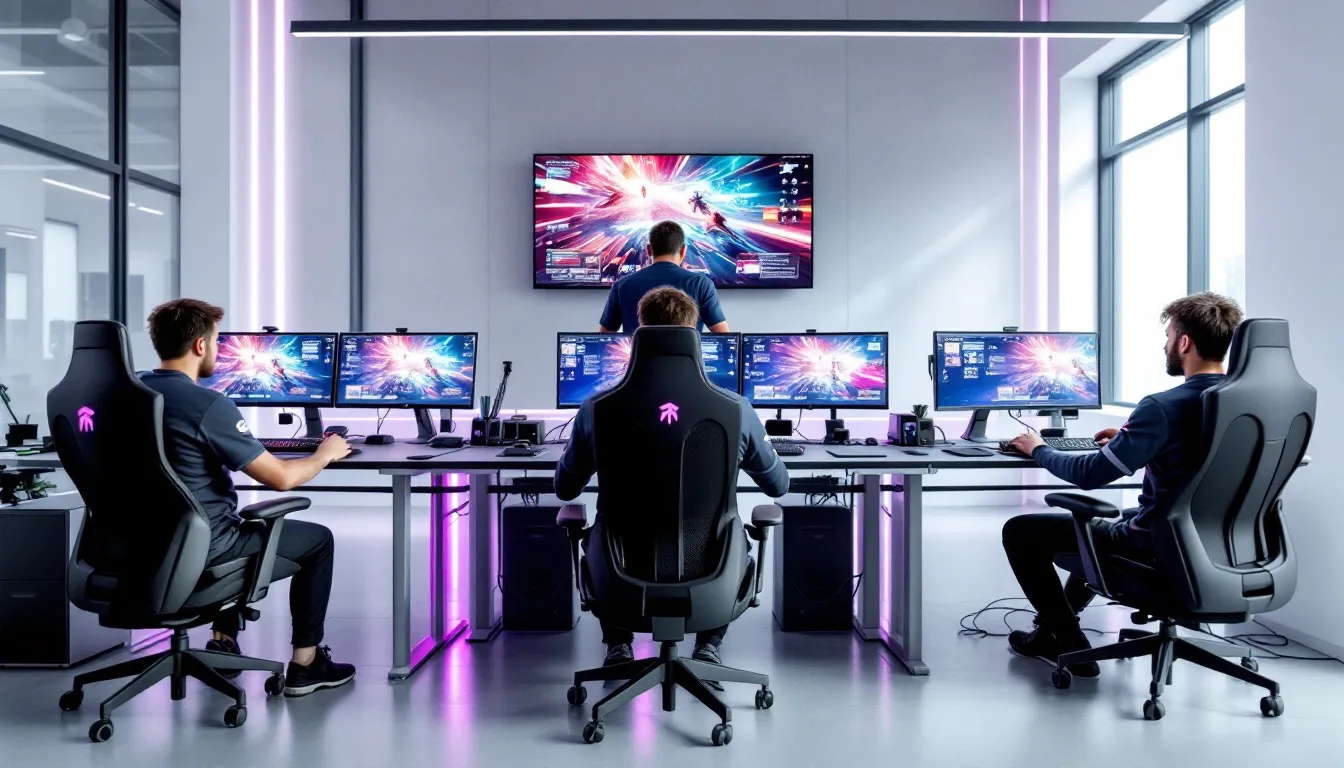
Beyond individual setups, most houses have a main training room where the full roster can scrim together. This room is usually the largest, with desks arranged so players can see each other’s screens if needed, plus a coaching station with a secondary monitor for real-time VOD review.
Some houses also include a well-equipped gaming desk setup with cable management, ergonomic chairs (Herman Miller Aerons are practically standard issue), and acoustic treatment to reduce echo during comms.
High-Speed Internet and Network Infrastructure
Nothing kills a scrim faster than lag. Modern gaming houses run on enterprise-grade internet: symmetrical gigabit fiber at minimum, sometimes bonded connections for redundancy. Ping consistency matters more than raw speed, teams pick ISPs and locations with low-latency routes to game servers.
Inside the house, you’ll find commercial-grade routers and managed switches. Ubiquiti UniFi setups are popular, they allow network segmentation so streaming traffic doesn’t choke scrim sessions. Some houses even wire Ethernet to every desk (Wi-Fi is a last resort for pros).
Bandwidth management tools ensure fair allocation. If five people are streaming, two are in ranked, and someone’s downloading a 100GB game update, QoS rules keep everything smooth.
Living Quarters and Personal Space Considerations
This is where many gaming houses stumble. Cram five competitive egos into tight quarters with no privacy, and burnout or drama is inevitable.
Smart houses ensure each resident has a private bedroom, a space to decompress, take calls, or just escape team dynamics. Shared spaces like kitchens and living rooms are kept clean (house rules help), and some setups include multiple bathrooms to avoid morning bottlenecks.
Noise isolation matters, too. Soundproofing between bedrooms and practice areas means someone can sleep while others are scrimming. Blackout curtains, white noise machines, and personal climate control all contribute to better rest, which directly impacts performance.
Streaming Studios and Content Production Areas
A dedicated streaming room separates content creation from competitive practice. These rooms are decked out with professional lighting (key, fill, and back lights to avoid the “basement gamer” look), camera setups (Sony A7-series or Panasonic Lumix are common), and acoustic foam.
Some houses include a podcast or interview room with multi-camera setups, a mixing board for audio, and comfortable seating. This doubles as a space for sponsor content, team announcements, or collab videos.
Editing workstations, usually beefier PCs with high-core-count CPUs and ample storage, sit in quieter corners of the house. A dedicated editor or content manager often handles post-production, freeing up players to focus on performance.
Famous Gaming Houses That Changed the Industry
Some gaming houses transcended their walls to become legends in their own right. These setups didn’t just produce wins, they redefined how teams approach training and collaboration.
Legendary Esports Team Houses
Team SoloMid (TSM) League of Legends House – Based in Los Angeles, TSM’s LoL house became iconic in the early 2010s. It was one of the first to feature dedicated coaching staff, scheduled scrims, and a professional environment. TSM’s success, multiple NA LCS titles, proved the model worked. Their vlogs and house tours helped normalize the concept for fans.
Cloud9 CSGO House – Cloud9’s Boston boot camp house in 2018 became legendary after the team’s historic Major win. The house wasn’t permanent, but the focused, high-pressure environment helped them clinch North America’s first CS Major. It showed that even temporary gaming houses could deliver results when timed right.
T1 (formerly SK Telecom T1) Korea House – Home to Faker and multiple Worlds-winning rosters, T1’s Seoul facility set the gold standard for infrastructure. It wasn’t just a house, it was a full training complex with coaches, analysts, chefs, and even a gym. The results speak for themselves: multiple World Championships and sustained dominance.
FunPlus Phoenix (FPX) Valorant House – In 2023, FPX set up a Shanghai gaming house that blended traditional Chinese discipline with modern esports infrastructure. Their 2024 Valorant Champions run was fueled by months of coordinated bootcamp-style training. The house featured integrated analytics rooms where coaches could pull live stats mid-scrim.
Influencer Collaboration Houses
FaZe House 1.0 and Beyond – FaZe Clan pioneered the content creator house model. Their early LA houses were less about competitive grinding and more about cranking out viral content. Trick shots, pranks, collabs, all designed to grow the brand. By 2026, FaZe runs multiple properties globally, each tailored to specific content verticals.
OfflineTV House – A collective of variety streamers and YouTubers, OfflineTV’s houses (they’ve moved a few times) became famous for their laid-back, collaborative vibe. Resident creators like Pokimane, Disguised Toast, and others produced streams, podcasts, and videos that blurred the line between reality TV and gaming content. The chemistry was genuine, and fans ate it up.
100 Thieves Cash App Compound – 100 Thieves’ LA facility is part training center, part content studio, part streetwear HQ. It’s a hybrid model: competitive rosters train there, but so do content creators and apparel designers. The integration shows how modern orgs view gaming houses as multi-functional brand hubs.
Amp House – Launched by Kai Cenat and other Twitch/YouTube stars, Amp House represents the next wave: pure content creation with minimal competitive focus. It’s organized chaos, streams, IRL content, collabs, all designed to maximize watch time and engagement. The house itself became a character in the content.
The Pros and Cons of Gaming House Life
Gaming houses aren’t for everyone. The same factors that make them effective, constant proximity, shared goals, blurred work-life boundaries, can also become sources of friction.
Advantages: Training Efficiency and Team Bonding
The efficiency gains are undeniable. Scrims start on time because nobody’s stuck in traffic. VOD review happens immediately after matches while details are fresh. Strategy discussions flow naturally over meals or downtime, so you’re iterating constantly instead of waiting for the next scheduled meeting.
Team bonding accelerates, too. Shared experiences, pulling all-nighters before a qualifier, celebrating a tournament win, even just binging a show together, create cohesion that remote teams struggle to replicate. Inside jokes become shorthand comms. You learn to read your teammates’ moods and adjust on the fly.
For content creators, the advantages are similar: collaboration becomes effortless, production timelines compress, and the creative energy of having peers around can be infectious. Ideas bounce around naturally, and you’ve got built-in guests or co-hosts whenever you need them.
Challenges: Privacy, Burnout, and House Dynamics
Living where you work means it’s hard to clock out. When your bedroom is 20 feet from your practice station, the temptation (or pressure) to grind one more session is constant. That can lead to burnout faster than you’d think.
Privacy becomes a luxury. Even with private bedrooms, shared spaces mean you’re rarely truly alone. If you’re an introvert or just need personal space to recharge, gaming house life can be draining.
House dynamics are the silent killer. Personality clashes, differing cleanliness standards, conflicting schedules, these friction points escalate when you can’t escape them. One toxic personality can poison the entire environment. Teams that don’t establish clear rules and conflict resolution processes often implode.
There’s also the risk of cliques forming. In a five-person house, if three players bond tightly and exclude the other two, in-game communication and trust can fracture. Management needs to actively monitor and address social dynamics, something many orgs underestimate.
Finally, roster changes hit harder. When a teammate gets benched or leaves, it’s not just a professional shift, it’s a roommate moving out. That emotional weight can linger and affect morale.
How to Start Your Own Gaming House
Thinking about starting a gaming house? It’s doable, but it requires planning, capital, and realistic expectations. Here’s the roadmap.
Finding the Right Location and Property
Location matters more than you might think. Proximity to game servers is critical, if you’re grinding NA servers, living in California or Texas gets you better ping than Florida. For EU teams, Germany or the Netherlands are popular for central server access.
Consider the local esports ecosystem, too. Cities like LA, Seoul, Berlin, and Shanghai have established gaming infrastructure: nearby LAN centers, other pro teams for scrims, and sponsor/media opportunities. Smaller cities are cheaper but more isolated.
For the property itself, prioritize:
- Enough bedrooms for private space (one per resident minimum)
- Large common area that can fit a full scrim setup
- Multiple bathrooms to avoid bottlenecks
- Good bones for internet: confirm fiber availability before signing
- Landlord flexibility: some landlords balk at high power usage or unconventional setups
Leasing is safer than buying unless you’re an established org. A 12-month lease lets you test the model without overcommitting.
Budgeting for Setup and Monthly Expenses
Be honest about costs. Here’s a rough breakdown for a five-person house in a mid-tier US city:
One-time setup:
- Security deposit + first/last month rent: $6,000–$12,000
- Gaming PCs/consoles (5 stations): $10,000–$25,000 depending on specs
- Monitors, peripherals, chairs: $5,000–$10,000
- Networking gear (router, switches, cabling): $1,000–$2,000
- Furniture (beds, desks, couches): $3,000–$6,000
- Streaming/content gear (cameras, lights, mics): $2,000–$5,000
Total setup: $27,000–$60,000
Monthly expenses:
- Rent: $2,500–$5,000
- Gigabit internet: $100–$300
- Utilities (power, water, gas): $300–$600 (gaming rigs eat power)
- Groceries/food: $1,000–$2,000 (split five ways: $200–$400/person)
- Cleaning supplies, household misc: $100–$200
Total monthly: $4,000–$8,100, or $800–$1,620 per person
If you’re serious about competing, budget for a coach or analyst as well ($2,000–$5,000/month depending on experience).
Selecting Compatible Teammates or Housemates
Skill alone doesn’t make a good housemate. You need compatible personalities, work ethics, and life habits. Before committing to a lease, consider a trial period: bootcamp together for two weeks at an Airbnb or similar. See how people handle stress, mess, and downtime.
Discuss expectations upfront:
- Practice schedule: How many hours daily? Rest days?
- Content commitments: Is everyone streaming? What’s the upload cadence?
- Cleanliness standards: Who handles chores? Rotating schedule or hire help?
- Guests and relationships: Are significant others allowed to visit/stay?
- Substance policies: Alcohol? Smoking? Zero tolerance or house vote?
Red flags to watch for: chronic lateness, poor communication, extreme introversion or extroversion mismatches, unrealistic expectations about success timelines.
Establishing House Rules and Schedules
Put everything in writing. A house agreement isn’t legally binding like a lease, but it sets expectations. Include:
- Scrim/practice blocks: When are mandatory team sessions? When is solo queue okay?
- Quiet hours: When should noise be minimized for sleeping residents?
- Chore rotation: Who cleans what, and when?
- Expense splits: Equal shares or proportional to income?
- Conflict resolution process: How do you handle disputes? House vote? Mediation?
- Exit terms: What happens if someone wants out mid-lease?
Schedules should balance structure and flexibility. A sample week might include:
- Monday–Friday: 12 PM–6 PM team scrims/VOD review: 7 PM–11 PM solo queue or content
- Saturday: Tournament day or team strategy sessions
- Sunday: Rest/personal time
Adjust based on your game and goals, but avoid the trap of “grind 24/7”, burnout kills more teams than lack of skill.
Gaming House Technology and Equipment Checklist
Setting up a gaming house means outfitting it with the right gear. Here’s what you actually need, broken down by category.
Gaming PCs, Consoles, and Peripherals
PCs (if applicable):
- CPU: Intel i7-14700K or AMD Ryzen 7 7800X3D minimum for competitive titles
- GPU: NVIDIA RTX 4070 or higher (RTX 4080/4090 for max settings + streaming)
- RAM: 32GB DDR5 (overkill for most games, but future-proof and good for multitasking)
- Storage: 1TB NVMe SSD minimum (2TB preferred for multiple game installs)
- Cooling: Quality AIO liquid cooler or high-end air cooler (houses can get warm with multiple PCs running)
Consoles:
- PlayStation 5, Xbox Series X, or Nintendo Switch depending on your titles
- Consider multiple units if your team competes in console-exclusive games
Peripherals:
- Monitors: 240Hz+ for competitive FPS/MOBA (brands like ASUS ROG, BenQ Zowie, Alienware): some setups benefit from dual monitors (one for game, one for Discord/guides)
- Keyboards: Mechanical, tournament-proven (Logitech G Pro X, SteelSeries Apex Pro, Razer Huntsman)
- Mice: High-DPI, low-latency wireless or wired (Logitech G Pro Wireless, Razer Viper, Finalmouse)
- Headsets: Closed-back for noise isolation (SteelSeries Arctis Pro, HyperX Cloud II, Logitech G Pro X)
- Chairs: Ergonomic, not just RGB racing seats (Herman Miller Aeron, Steelcase Gesture, SecretLab Titan if budget)
Many players have highly specific preferences, so budget for personalization. Standardizing mice/keyboards across the team can help with backups, though.
Networking Gear and Bandwidth Management
Internet Service:
- Gigabit fiber (symmetrical upload/download) is the baseline
- Business-class service offers better SLAs and support: worth it if budget allows
- Redundant connection (secondary ISP) for mission-critical houses
Router & Switches:
- Router: Ubiquiti Dream Machine Pro or similar enterprise-grade router with QoS and VLAN support
- Switches: Managed Gigabit switches (Ubiquiti, Netgear, TP-Link) for traffic control
- Ethernet cables (Cat6 or Cat6a) run to every gaming station, Wi-Fi is backup only
QoS Configuration:
- Prioritize game traffic and voice comms over streaming and downloads
- Set bandwidth limits for background tasks (OS updates, cloud backups) during scrim hours
Some houses hire a network admin for initial setup and ongoing maintenance. It’s worth it if no one on the team is tech-savvy.
Streaming and Recording Equipment
Cameras:
- Webcams: Logitech StreamCam or Razer Kiyo Pro for quick setups
- Mirrorless cameras: Sony A7 III, Panasonic Lumix GH5 for professional quality (requires capture card)
Microphones:
- USB: Shure MV7, Audio-Technica AT2020USB+ for solo streams
- XLR: Shure SM7B, Electro-Voice RE20 paired with audio interfaces (GoXLR, Focusrite Scarlett) for top-tier sound
Lighting:
- Key light, fill light, and optional backlight (Elgato Key Light, Neewer LED panels)
- Diffusers and softboxes for flattering, shadow-free lighting
Capture Cards:
- Elgato HD60 X, AVerMedia Live Gamer Ultra for console capture or dual-PC streaming setups
Streaming PCs (optional):
- Dedicated encoding rig for high-quality streams without impacting gaming performance
- Specs: i7/Ryzen 7, RTX 4060 Ti or better, 16GB RAM
Software-wise, OBS Studio is free and industry-standard. Some creators pay for Streamlabs or XSplit for added features. Audio routing (Voicemeeter, GoXLR software) ensures clean, professional sound mixes.
For those optimizing their entire production workflow, guides on gaming table accessories and peripheral organization can help reduce desk clutter and streamline content creation.
The Future of Gaming Houses in Competitive Gaming
Gaming houses aren’t going anywhere, but the model is evolving. Remote work reshaped how we think about collaboration, and esports is no exception. Here’s where things are headed in 2026 and beyond.
Hybrid Models: Remote vs. In-Person Training
Pandemic-era lockdowns forced teams to prove that remote training works. Turns out, you can run effective scrims, VOD reviews, and even bootcamps online, if you have the right tools. But purely remote setups lack the intangible benefits of in-person collaboration: instant feedback, body language, spontaneous strategy sessions.
The solution? Hybrid models. Teams maintain a gaming house but don’t require year-round residence. Instead, players live independently most of the time and converge for intensive bootcamps before majors, playoffs, or roster integrations. This approach balances efficiency with personal space, reducing burnout while preserving the synergy boost when it matters most.
Some orgs are experimenting with rotating residency: two players live in the house each month while others join for scheduled practice blocks. This keeps overhead manageable and gives everyone breathing room.
Remote tools have also improved dramatically. Low-latency voice with spatial audio (Discord’s Krisp noise suppression, TeamSpeak’s 3D audio), real-time VOD annotation platforms, and AI-powered analytics mean remote teams can replicate some of what houses offer. But for the highest level of competition, in-person bootcamps remain non-negotiable.
Virtual Reality and Emerging Technologies
VR training isn’t science fiction anymore. In 2026, some FPS teams use VR for aim drills, spatial awareness training, and even team coordination exercises. VR can simulate match pressure and replicate scenarios that are hard to set up in-game. According to insights on VR gaming setups, the hardware has matured to the point where latency and comfort are no longer dealbreakers.
Gaming houses are starting to include VR training rooms, dedicated spaces with motion tracking, haptic vests, and custom software. It’s niche today but growing, especially in tactical shooters and games where positioning matters.
AI coaching tools are also entering gaming houses. Software that analyzes replays, flags mistakes, and suggests optimizations is getting scary good. Some houses have an AI “assistant coach” running 24/7, flagging patterns and generating reports for human coaches to review. Players love it or hate it, no middle ground.
Emerging display tech is another frontier. MicroLED monitors with zero input lag, ultra-wide aspect ratios for immersive sims, and even holographic displays for strategy planning are starting to appear in top-tier houses. Reviews from monitor testing experts confirm these technologies are ready for competitive use, though cost remains prohibitive for most setups.
Finally, metaverse-style virtual houses are being prototyped. Imagine a VR space where remote teammates can “move in” virtually, avatars hang out in a shared virtual house, practice in virtual arenas, then log into the real game for matches. It sounds gimmicky, but for global rosters where visas or geography make physical houses impossible, it’s a compelling middle ground.
The culture around gaming houses is shifting too. Coverage from gaming and entertainment outlets highlights how houses are becoming content in themselves, reality-show-style series, behind-the-scenes vlogs, and fan engagement events. The line between competition and entertainment continues to blur, and houses are at the center of that evolution.
Conclusion
Gaming houses have come a long way from cramped apartments with questionable internet. In 2026, they’re sophisticated, purpose-built environments where competitive teams sharpen their edge and content creators push the boundaries of what’s possible in gaming entertainment.
Whether they’re the right move depends on your goals, budget, and team dynamics. For aspiring pros chasing championship runs, the synergy and efficiency gains can be game-changing. For content creators, the collaboration and production capabilities unlock opportunities that solo setups can’t match. But the model demands commitment, clear communication, and realistic expectations about the challenges of living and working under one roof.
If you’re serious about exploring a gaming house, start small. Test the waters with a short-term bootcamp before signing a year lease. Invest in the right infrastructure, especially networking and personal space, and establish house rules from day one. Done right, a gaming house isn’t just a place to grind: it’s a launchpad for the next stage of your competitive or content career.
The future of gaming houses is hybrid, tech-forward, and increasingly integrated with the broader entertainment landscape. Whether you’re moving in or just curious, one thing’s certain: the gaming house model is here to stay, evolving with the industry it helped build.